
Most Canadian Employers Don’t Have a Parental Leave Policy. Does Yours?
Nearly 40% of Canadian employees receive no employer top-up during maternity or parental leave. Most companies with under 500 people have no written policy at all. And every day, someone at a growing Canadian company announces they're expecting — while their HR manager quietly opens a new Google tab.
This is that tab. But better.
This guide is for anyone responsible for people at a Canadian organization — founders, HR leads, operations managers, and the office manager who somehow ended up owning HR. We'll cover what the government actually provides (and what it doesn't), how to build a policy that's competitive without breaking your budget, the legal obligations you cannot ignore, and what separates employers who keep their best people after leave from those who don't.
At the end, there's a free interactive tool — built by HR Success Centre — that runs your cost scenarios and generates a complete, ready-to-use policy document in minutes.
No recycled templates. No vague best practices. Just what you actually need to make a decision and implement it.
Part One: The Uncomfortable Truth About Canadian Parental Leave
Canada has a reputation — internationally, at least — for being generous with maternity leave. And in some ways, that's true. The federal Employment Insurance program covers new parents for up to 18 months. Job protection is legally guaranteed. Compared to the United States, where there is no federal paid parental leave requirement at all, Canada looks progressive.
But here's what gets glossed over: nearly 40% of Canadian mothers receive no employer top-up during their leave at all. Of those who do receive a top-up, more than half receive no additional support — no coaching, no phased return, no structured check-in. The government's portion — which employees have been paying into through EI premiums their entire working lives — covers 55 cents on the dollar for standard leave, with a weekly cap.
For an employee earning $75,000 per year, their normal weekly earnings are about $1,442. During leave, standard EI benefits would provide up to $729 per week—roughly half of their regular income, leaving a gap of about $713 per week.
While more than half of Canadian employers provide a top-up for pregnancy leave benefits, only 33% offer top-ups for parental leave benefits — which means the majority of non-birthing parents, including fathers, adoptive parents, and same-sex couples, receive nothing beyond EI.
Most companies with fewer than 500 employees don't offer any top-up at all. It's a gap in the market for employers willing to think about retention differently.
The expectation gap is real. Employees — especially those in knowledge work, tech, and professional services — increasingly expect a top-up. They've heard what competitors offer. They've talked to friends at other companies. And when they don't get it, they notice. Sometimes they leave.
The policy gap is equally real. Hiring the wrong person or operating without clear policies can create significant risks for businesses in their early stages. Parental leave is one of the most common areas where the absence of a written, communicated policy creates both legal exposure and employee relations problems — especially when the first leave happens to a senior employee or a key team member.
This playbook exists to close both gaps.
Part Two: What the Government Actually Provides
Before you can build your policy, you need to understand the foundation it sits on. Canada's leave system is a two-part structure: the ESA governs the time, and EI governs the money.
The Employment Standards Act (ESA) — The Right to Time Off
In Ontario, the Employment Standards Act, 2000 (ESA) gives eligible employees the legal right to take unpaid, job-protected time away from work when they become a parent.
This is not optional for employers. You cannot deny it, shorten it, or require an employee to choose between their job and their leave.
To qualify for pregnancy leave, an employee generally must have started employment at least 13 weeks before their expected due date.
There are two separate leave types under the ESA:
Pregnancy Leave
Pregnancy leave is available to the employee who is pregnant or gives birth, including surrogates. It provides up to 17 weeks of unpaid, job-protected leave and can begin as early as 17 weeks before the due date.
This leave is only available to the birthing parent.
Parental Leave
Parental leave is available to all new parents: birthing parents, non-birthing parents, and adoptive parents.
Under Ontario ESA:
Employees who took pregnancy leave may take up to 61 weeks of parental leave
Employees who did not take pregnancy leave may take up to 63 weeks
Parental leave must begin:
immediately after pregnancy leave (if pregnancy leave was taken), or
within 78 weeks of the child’s birth or placement for adoption.
Each eligible parent has their own parental leave entitlement, and parents may take leave at the same time or at different times.
Here’s an important nuance many employers miss:
When pregnancy leave and parental leave are combined, a birthing parent may be away on ESA-protected leave for up to 78 weeks total — nearly a year and a half.
During that time, employers must:
maintain job protection
continue benefits (unless the employee declines participation)
preserve seniority and service-related entitlements
The minimum notice an employee is generally required to give is two weeks before leave begins.
For early births or unexpected circumstances, even that may not be possible. Employers can request more notice as a planning preference, but cannot require more than the ESA permits.
Employment Insurance (EI) — The Income
EI is the federal income replacement program many Canadians rely on during parental leave.
Employees apply directly through Service Canada. EI is separate from provincial employment standards and is not paid by the employer unless the employer chooses to offer a top-up.
There are three major EI benefit categories relevant to parental leave:
Pregnancy (Maternity) Benefits
Available only to the birthing parent.
Provides up to 15 weeks of EI at:
55% of average insurable earnings
up to $729/week (2026 maximum)
This typically runs before parental benefits begin.
Standard Parental Benefits
Provides:
55% of average insurable earnings
up to $729/week
up to 35 weeks for one parent
or 40 shared weeks between parents (with no parent receiving more than 35 weeks)
This option provides higher weekly income over a shorter leave period.
Extended Parental Benefits
Provides:
33% of average insurable earnings
up to $437/week
up to 61 weeks for one parent
or 69 shared weeks between parents
This option provides lower weekly income over a longer leave period.
These weekly amounts are maximums—not what everyone receives.
For example:
Employees earning below the maximum insurable earnings threshold ($68,900 in 2026) receive a percentage of their actual earnings, not the capped amount.
EI eligibility and payment timing also depend on insurable hours and claim details.
One important note:
The standard EI waiting period is traditionally one week, but it is currently temporarily waived for claims starting through October 10, 2026 under a federal temporary measure.
Employers should confirm current EI rules directly with Service Canada, since these rules can change.
Quebec Is Different
Quebec does not use federal EI maternity and parental benefits.
Instead, Quebec employees are covered by the Quebec Parental Insurance Plan (QPIP).
QPIP has:
different eligibility rules
different leave structures
generally higher wage replacement than federal EI
If you employ Quebec-based workers, federal EI assumptions do not apply.
What the Government Does NOT Cover
The system is helpful.
It is often not enough.
The math becomes very real, very quickly.
An employee earning $90,000 per year earns about $1,731 per week.
Under standard EI, they may receive up to $729 per week.
That replaces just 42% of their regular earnings.
Even an employee earning $60,000 per year earns about $1,154 per week.
At the EI maximum, that means income replacement of roughly 63%.
That gap matters.
Employees on leave are often making major life decisions during this period:
When can we afford childcare?
Can we afford to stay off longer?
Should I return earlier than planned?
Should I look for an employer with a better leave policy?
How employers support employees during this period often shapes retention, trust, and long-term loyalty far more than leaders realize.
Part Three: The Case for Doing More
There is no legal requirement to offer a top-up. Let's be direct about that. You can meet your obligations under the ESA, file the ROE, wish your employee well, and technically be compliant.
But compliant and competitive are not the same thing.
Here's the business case for going further, broken down plainly:
Retention Is the ROI
Do the math on a 17-week top-up to 80% of salary for an employee earning $70,000 per year: the employer cost is roughly $5,900.
That’s often less than the cost of replacing a strong employee. The Society for Human Resource Management estimates that replacing a single employee can cost anywhere from one-half to four times their annual salary, depending on role complexity, recruiting costs, onboarding, lost productivity, and ramp-up time.
A thoughtful parental leave policy — especially one that includes employer top-up — can improve retention, strengthen trust, and reduce turnover risk during one of the most important transitions in an employee’s life.
A top-up that helps retain a high-performing employee isn’t just a benefit expense. It can be a smart retention investment.
The Talent Market Is Watching
Almost three-quarters of Canada's Top 100 Employers applicants now offer some level of maternity or parental leave top. For employers competing for professional talent, especially in tech, financial services, healthcare, and professional services, a policy with no top-up is increasingly seen as a red flag — not a neutral fact.
Candidates ask about parental leave in interviews now. They check Glassdoor. They talk to people who work at your company. "We just offer what the government provides" is an answer that registers.
Equity Isn't Theoretical — It's Operational
Parental leave is one of the few benefits with a direct and documented gender equity dimension. When only birthing parents receive top-ups (a still-common practice), the message — intentional or not — is that only one type of parent's leave is valued. When parental discrimination happens, it often starts not with explicit bias but with the assumption that a parent on leave is less serious, less committed, less promotable.
Building a gender-neutral policy — one where all parents receive the same support regardless of how they came to parenthood — is one of the most concrete things an employer can do to improve equity in the workplace. Not as a statement, but as a practice.
It Removes a Painful Negotiation
Without a policy, every leave becomes a negotiation. The employee asks what you offer. You make something up, or defer, or promise to get back to them. That moment of uncertainty is uncomfortable for everyone. The employee wonders if they're being treated fairly. The manager worries about setting a precedent. The founder doesn't know what's reasonable.
A written policy eliminates that entire conversation. The policy exists. Here it is. We're all working from the same document.
Part Four: What Great Actually Looks Like
Most guides on maternity & parental leave focus on the legal minimum and call it done. This section is about what employers who actually want to be good at this do differently.
On Top-Ups
The most common structure among Ontario employers of choice is a top-up to 80% of salary for the first 17 weeks of leave (the pregnancy leave period). This is a reasonable floor for a company that wants to be competitive without taking on significant cost.
Among employers offering parental leave top-ups, 84% top up to between 75% and 100% of regular earnings. If you're going to offer a top-up at all, a 50% top-up is unlikely to meaningfully change the employee experience — the sweet spot is 80%+.
For extended parental leave specifically, think through your approach in advance. An employee who chooses extended leave will receive lower EI payments, which means your top-up cost — if you match it to a percentage of their salary — goes up. Many employers handle this by specifying that they'll top up to the equivalent of what standard EI would have paid, rather than committing to a percentage of salary regardless of leave type. Either approach is valid; what matters is that it's written down so there's no ambiguity.
On Timing
The old assumption that employees must always serve a one-week EI waiting period is no longer universally true.
Historically, Employment Insurance included a one-week waiting period before benefits began. However, that waiting period is currently temporarily waived for eligible claims through October 10, 2026 under a federal temporary measure.
Even when no waiting period applies, employees may still experience a gap between when leave starts and when EI payments actually arrive. In practice, EI deposits often take several weeks after application to be processed, depending on claim timing and Service Canada processing volumes.
A thoughtful parental leave policy addresses this reality. Employers should decide whether to:
cover the income gap directly through employer top-up, or
clearly communicate expected payment timing so employees can plan ahead.
That gap matters more than many employers realize — especially during the first few weeks of leave, when families are managing major financial and personal transitions.
On Non-Birthing Parents
One of the clearest signals of a progressive parental leave policy is whether it applies equally to non-birthing parents. When paternity leave is offered at a lower rate, for fewer weeks, or not at all, the implicit message is that caregiving is gendered. It also means that fathers and non-birthing parents return to work sooner, which reinforces unequal division of household labour and limits the effectiveness of the policy in reducing the career penalty women face after childbirth.
The most effective approach: same top-up, same weeks, same access for all parents.
On Return to Work
The return from parental leave is as important as the leave itself — and it's where most employers fall short. An employee who has been away for months is returning to a team that has changed, a project that has evolved, and a desk (or Slack workspace) where priorities have shifted. If you drop them back in with no re-onboarding and expect them to be productive in week one, you'll get a rough transition for everyone.
Consider: a structured re-onboarding meeting, a phased return option (three days a week for the first two to four weeks), clarity on what's changed, and an explicit offer to discuss flexibility. None of these cost significant money. All of them make a real difference in how the return feels — and whether the person stays.
On Equity and Vesting
One area almost universally missed in small-company parental leave policies: equity vesting. If employees hold stock options or participate in an equity plan, their vesting typically pauses during unpaid leave — which means a parent taking a year away from work may lose months of equity they were expecting to earn. Best practice is for vesting to continue during parental leave, and for this to be documented explicitly. If it's not in your policy, it's a conversation waiting to happen in the worst moment.
On Pregnancy Loss
Many parental leave policies say nothing about pregnancy loss or stillbirth. In Ontario, employees who experience pregnancy loss after 17 weeks of pregnancy are typically still entitled to pregnancy leave under the ESA. Beyond the legal obligation, employees navigating pregnancy loss need to know they're supported — that their time away is recognized, that they won't have to explain themselves to get it, and that they can access bereavement support through their benefits. If your policy is silent on this, it's worth adding a line.
Part Five: The Real Cost of a Top-Up
This is where most pregnancy and parental leave guides get vague.
Let’s make it practical.
The cost of offering a maternity leave top-up is more predictable than many employers think.
The formula is straightforward:
Employee weekly salary = annual salary ÷ 52
EI weekly payment = 55% of weekly earnings, up to the federal EI maximum
Employer top-up per week = target income replacement − EI payment
Total employer cost = weekly top-up × number of weeks × number of employees
In simple terms, you’re covering the gap between what EI pays and the income level you want employees to receive while on leave.
For example, if your policy targets 80% salary replacement, the employer only pays the difference between:
the employee’s EI benefit, and
80% of their regular weekly salary
That means the cost depends on three things:
employee salary
top-up percentage
number of weeks covered
A few important patterns show up quickly.
Lower salaries = lower employer cost
For lower-earning employees, EI already replaces a meaningful percentage of income.
That means the employer top-up required to reach 80% is often relatively modest.
Higher salaries = higher employer cost
For higher earners, EI reaches its maximum weekly cap quickly.
Once that happens, EI stops scaling with salary—but your top-up cost keeps rising.
That means the higher the salary, the more the employer pays to bridge the gap.
Most employers are dealing with a predictable cost—not a surprise cost
For most companies, parental leave is not an unpredictable expense.
It’s a modelable workforce cost.
If you have a team of 20 employees and historically one or two employees take leave each year, you can forecast this with surprising accuracy.
That makes policy planning much easier.
Instead of reacting case-by-case, employers can build a structured leave policy that balances:
employee support
retention
budget predictability
It’s also worth noting that employer-paid top-up costs are generally treated as a deductible business expense in Canada, though tax treatment should always be confirmed with your finance team or accountant.
The bigger point is this:
A well-designed parental leave policy usually costs far less than employers assume.
And in many cases, the cost of replacing a strong employee is significantly higher than the cost of helping them stay.
That’s exactly why we built this calculator.
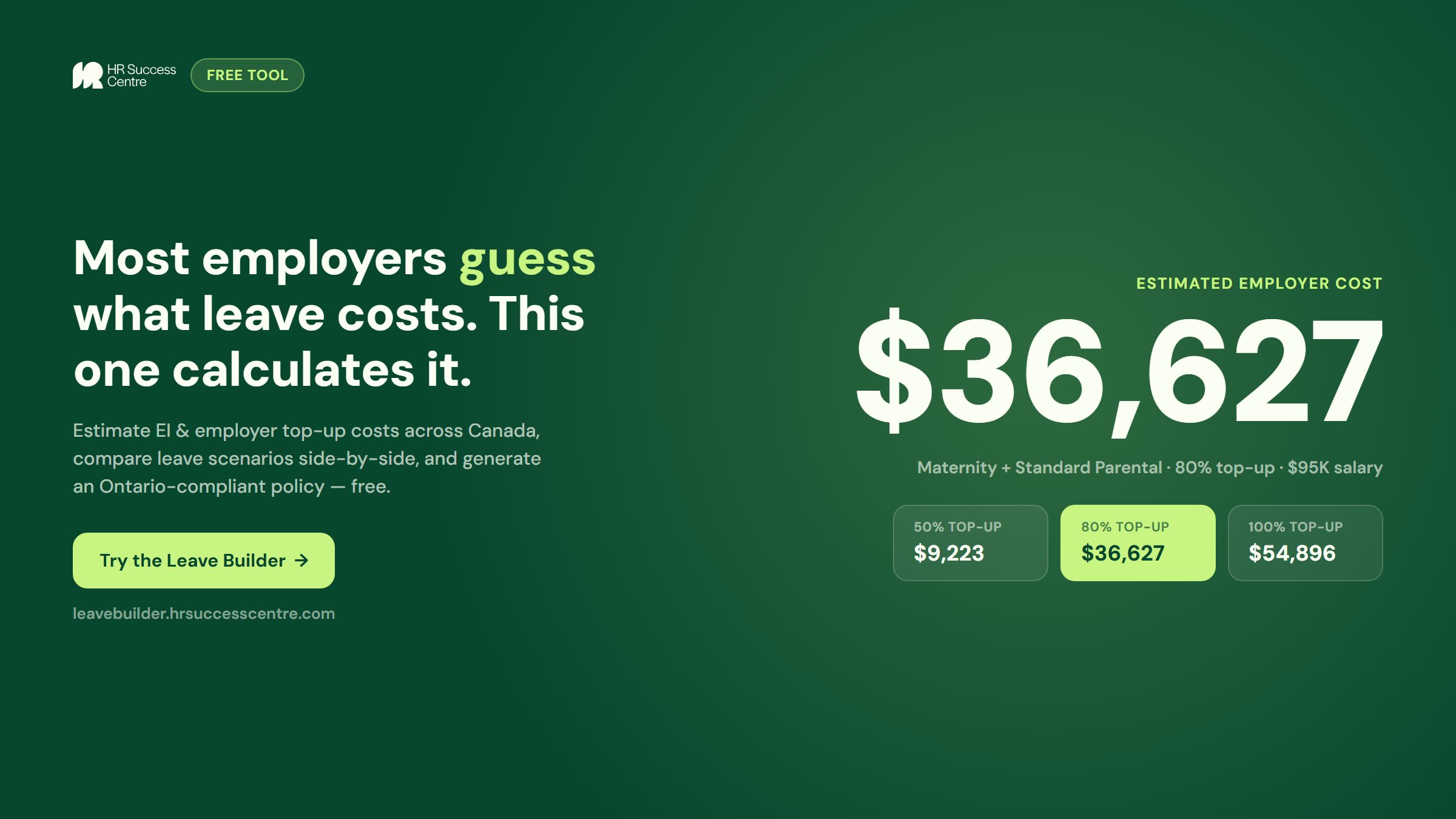
The tool models employer top-up costs across multiple maternity and parental leave scenarios so you can compare options and understand the real financial impact before making a policy decision.
Part Six: The Non-Financial Things That Matter Just as Much
Not every dimension of a great maternity & parental leave program costs money. Some of the highest-impact things you can do are entirely operational.
Communicate the policy publicly. Put it on your careers page. Include it in your offer letters. Talk about it in your employee handbook. A policy that exists but no one knows about is not a benefit — it's a liability. Employees who find out about top-ups from colleagues during their leave, rather than from HR before it starts, feel blindsided and undervalued even if the policy itself is generous.
Ask, don't assume. When an employee announces their leave, have a real conversation about what they need. Do they want to stay updated on key projects? Do they want to fully disconnect? Do they want a check-in at 3 months? There is no universal answer, and treating every parent the same is its own form of inflexibility.
Plan for coverage proactively. One of the most common complaints from managers about parental leave is that it creates a scramble. The solution is a transition plan, started early — typically six to eight weeks before the leave begins — that documents what the employee is responsible for, who covers what, and how knowledge gets transferred. This protects the employee, the team, and the returning parent (who doesn't want to come back to chaos).
Don't make assumptions about what parents can handle. This one is subtle but important. After a parent returns from leave, the temptation to "protect" them — by not offering a stretch assignment, not including them in a pitch, not flagging a promotion — is real. It's usually well-intentioned. It's almost always the wrong call. Let them decide what they can take on. Ask, don't assume.
Create space for parents at your company. A Slack channel, a lunch group, a peer network — something that signals to parents that they're not invisible here. This is especially meaningful for parents who are the first on their team to take leave, and for non-birthing parents who often feel like the system wasn't really designed for them.
Part Seven: Your Legal Obligations — The Non-Negotiables
There are things you must do. Let's be unambiguous about them.
You must grant the leave. You cannot deny pregnancy or parental leave to an eligible employee. Full stop. There is no business reason that overrides this.
You must file an ROE. When an employee begins their leave, you file a Record of Employment so Service Canada can calculate and begin their EI payments. This is administrative and mandatory — delays cost your employee real money.
You must continue benefits. In Ontario, group benefits — health, dental, life insurance — continue during pregnancy and parental leave, provided the employee continues to pay their share of premiums (if any). Discontinuing benefits during leave is a violation.
You must continue accruing vacation and seniority. Time on parental leave counts toward an employee's tenure for all purposes: vacation entitlements, seniority, length-of-service awards. It cannot be treated as a gap or a pause.
You cannot penalize them. You cannot let someone go, demote them, reduce their compensation, or pass them over for a promotion because they went on parental leave. You also cannot ask — in an interview or otherwise — whether a candidate plans to have children.
You must reinstate them. When an employee returns, they have the right to return to their same job, or a comparable one with the same pay and benefits. "Comparable" is not a loophole — it means substantively equivalent, not a different role with a different scope dressed up as equivalent.
What you cannot do is ask an employee to do work during their leave, require them to return earlier than planned, or hint that their absence is affecting their standing at the company.
Part Eight: The Checklist
Before an employee goes on leave, here's what you should have in place:
As an organization:
A written parental leave policy that is publicly accessible
The policy included in your onboarding package
Every manager trained on what the policy says and what they can and can't ask
When someone announces their leave:
Schedule a dedicated leave planning meeting (not a five-minute chat at the end of a 1:1)
Walk through what the company offers — in writing
Discuss their preferred timeline, how they want the news shared with the team, and how they want to stay connected (or not) during leave
Create a transition plan with a specific handover document
Confirm their leave start date in writing
File the ROE when leave begins
Brief payroll and benefits administration
During the leave:
Honour whatever communication preferences were agreed upon
Include them in any compensation review cycles (with their consent) or document the plan to address this on return
Do not let their equity vesting silently lapse without discussion
When they return:
Schedule a re-onboarding meeting in advance — not on day one, before day one
Discuss any changes to team structure, priorities, or projects
Have a genuine conversation about flexibility, if relevant to their role
Check in at 30 and 60 days
Part Nine: Build Your Policy Now
We built the tool we wished existed.
The HR Success Centre Maternity & Parental Leave Builder is a free, interactive tool designed for Canadian employers. It does three things:
Cost Calculator — Enter a salary, choose a leave type, set the duration. See exactly what four different top-up scenarios cost your company side-by-side: no top-up, 50%, 80%, and 100%. The numbers update in real time. No spreadsheet needed.
Policy Builder — Answer a series of plain-language questions about what you want to offer, how you'll handle the return, and what perks you'll include. The tool generates a complete, ready-to-use parental leave policy document that you can download, edit, and implement. It's written in Ontario ESA language, gender-neutral throughout, and built on the frameworks in this guide.
Policy Advisor — Have a specific question about EI rules, ESA obligations, or how to handle an unusual situation? Our AI assistant is grounded in Ontario employment law and will give you a straight answer with a source reference. Not legal advice — but far better than a Google search.
The tool is free. No account required. It takes about ten minutes to generate a complete policy.
[Use the Parental Leave Builder → https://leavebuilder.hrsuccesscentre.com/]
A Final Note
Pregnancy & Parental leave is not an HR administrative task. It's a moment that matters to the people on your team in a way that almost nothing else does. The period around having or adopting a child is one of the most financially and emotionally significant stretches in most people's lives. How an employer handles it is remembered — for years.
You don't have to offer the most generous policy in your industry. You just need a policy that's thoughtful, fair, clearly communicated, and actually implemented.
This guide — and the tool that comes with it — is here to make that easier. Start with what you can afford, put it in writing, communicate it openly, and revisit it as your company grows.
That's it. That's the whole thing.
HR Success Centre is the destination for HR professionals and business leaders who are ready to actually use AI — not just read about it. We build tools, share implementation guides, and develop software that makes modern HR work. Explore what we're building at hrsuccesscentre.com.
Sources & Further Reading